Tove Gant (00:01.25)
Hi everyone, it’s Tove. I’m very excited to be back with Meg this week on the podcast. Thanks for having me, Meg. Well, I’m having you now.
Meg (00:09.851)
I know, I love it. And Tove, these sessions where you come and interview me are always some of my favorites because you and I get properly into the weeds, don’t we?
Tove Gant (00:17.646)
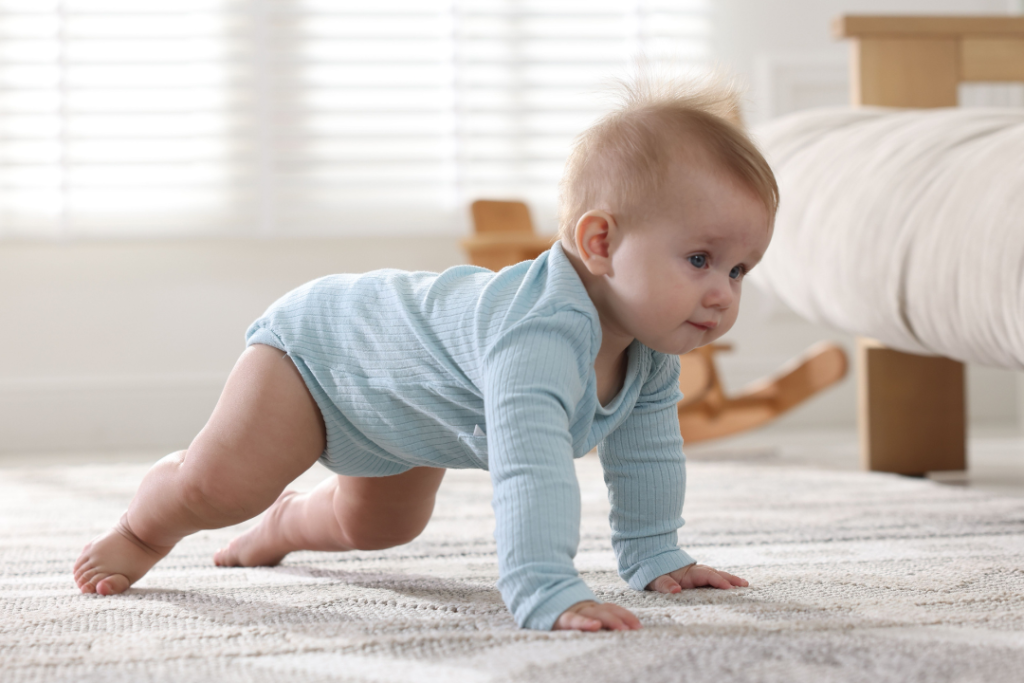
Yeah, we do. We like to go down the a very niche rabbit hole and today is no different. so today we are gonna discuss crawling. and Meg, I know I’ve heard you describe crawling as superfood. why? Why is crawling the superfood of development and why does it matter more than kind of most parents realise?
Meg (00:40.379)
It’s so interesting. You know, if you think about superfood, it’s the kind of the thing that feeds health and nutrition. superfoods are considered to be things that are very core in a diet for other things to kind of build on top of. And so we think about our prebiotics and our probiotics and our healthy gut and all of the superfoods that feed that is actually leading on into health. And in that way, crawling is like a superfood because it’s not just a milestone that gets ticked.
for what it is, like for instance, a smile is or like walking is. And that’s a milestone that you do for the milestone sake and you function in life because of it. The reason that I consider crawling a superfood is that it becomes the underpin of so many future types of development and so many other things get built on top of the core milestone of crawling. So it’s not just crawling for crawling sake because we all know we don’t do it. I mean, I don’t do it anymore. You don’t do it anymore. We don’t do it anymore.
So why is it then important? Why can’t we just skip it all together? And the reason that we really do prioritize crawling is because it actually is the superfood for a lot of other developmental milestones.
Tove Gant (01:49.697)
I actually remember with Gray, one of our first indicators that there was challenge was her missing her crawling milestone. And actually she only started crawling when she was just like fourteen months, fifteen months, which is late. And we had really intense OT intervention to get her to call. I remember the OT we worked with saying exactly that to us. She said
Don’t don’t even think about walking if you can’t get the crawling right. So I feel like for the first year of my life with her, I lived on the floor trying to get her to crawl.
Meg (02:18.002)
Mm.
Meg (02:26.597)
Yeah, and of course, you know, it’s really important that what was so hard for you in retrospect is that there were some fundamental basics that were going to stand in the way of crawling. And we’ll talk a little bit about that today. And so if you’d became this obsession that you needed to this box, but the problem was that you didn’t have the foundations before that. so crawling is an incredibly complex milestone. In fact, it is way more complex than sitting. mean, sitting, babysit.
Tove Gant (02:36.407)
Yes.
Meg (02:52.059)
almost all of them universally within two months of six months old. So in other words, either between five and seven months, most babies will start to sit because it’s such an easy milestone. And even a child who’s developmentally delayed, as Gray was, will sit and will potentially walk, but crawling is the one piece that’s really, really hard and where we often do see the delays.
Tove Gant (03:12.982)
Yeah, it’s unbelievable. They they were saying to me it and and how it kind of affects everything in the ecosystem, right? How it affects perceptory input and how it affects how she navigates her body in the world. And they were like, That’s why you have to get crawling right. Don’t worry about the the walking without the crawling. You’re really gonna struggle with all these other skills that she needs later on in life to be aware of her body. so I mean, we you’ve we’ve kind of navigated into the space already, but kind of most parents are
Meg (03:24.509)
Mm-hmm.
Meg (03:35.204)
Exactly.
Tove Gant (03:42.37)
racing towards walking because it’s always so cute to watch your little one walk. Why would you want a baby to crawl for longer and what’s lost when walking arrives too early at the expense of crawling?
Meg (03:53.428)
Yeah, know, so many parents like really pin a lot on walking. And I think it’s partly because we want to have only a handful of mammals that do that. And, you know, and it’s really only us and some primates who walk up on our back feet. So I think for the average lay person, it’s like, you know, this indicates that we are brilliant because only the top level of the primate pyramid do this on, you know, on two feet. Number one. Number two.
What we do know is that the minute you’re up on two feet, your hands are free to do something very useful. And so there’s a lot of focus on let’s get them off the ground and let’s get them up onto feet. Number three, crawling is messy. It just is. It is dirty. is messy. Knees get scuffed. Little ones get their hands into all sorts of things. Their hands and their feet and their knees are all dirty all the time. So we think, if we can get them on two feet, then their hands will be a little bit cleaner, which we won’t. And then if the…
of course, they’re the very cute shoes, which we really do want them to wear as early as possible, of course, in the average person’s mind. And so for a myriad of reasons, walking becomes, this is what I want my child to do. And so parents treat that as the finish line. So when little ones start to show that they’re standing, which they’ll often do, some of them very early, but most little ones by 10 months old are standing, taking weight on their two feet and even starting to cruise. And they might show interest in walking.
The immediate thing for a parent is, this is great. They’re going in the right direction. Let’s encourage it. And one of the things that I’m always saying to parents is don’t rush it because I promise you a child will walk. It’s a very, very small percentage of developmentally delayed children that don’t walk. Even those like Gray who are developmentally delayed do walk. So most little ones will walk, but don’t rush past this crawling phase because once it’s gone, it’s gone. And most of us obviously don’t use crawling anymore.
Tove Gant (05:41.238)
Yeah, it’s amazing. So when when should it typically happen? When does crawling typically emerge? What is the normal range? Because I mean I was just looking at my notes on my kids. So Gray was like 14 months, bear in mind she is a exception. Jagger was nine, but he was like a ginormous human, and Nova again, Premy. So she also had her own journey and she was eleven months.
But again, premi, so minus six weeks, whatever, so that’s ten. But like they were everywhere, right?
Meg (06:13.075)
Nine, yeah, so it’s about nine and a half months, Yeah, yeah. So look, when your baby crawls is actually less important than the sequence. So the sequence should be sit, crawl, walk. That’s kind of your ideal sequence of your trajectory. So that’s the most important thing. Exactly when it happens between sitting and walking is somewhat less important. So one of the things that we look at is that from about seven to eight months, little ones should start to crawl. It can happen earlier, but it’s
it’s not typical that it starts before seven months because actually you just don’t have the foundations to be able to actually start to crawl at that point. And we’ll talk about the foundations for crawling just now. But it can happen as late as 14 months and still be completely typical as long as it’s happening within the sequence that walking comes afterwards. know, walking is one of those weird milestones where you can get little ones who walk as late as 18 months and it’s still considered normal. And my middle nephew is case in point of that. had 18 months old, Ben wasn’t
walking and we were all like, was sitting there as the OT, putting my hand in my mouth, trying not to say anything and then thinking, my goodness, what does this indicate? And then when he started walking, he was immediately running. And that boy is now like a provincial cricket player, coordinated. His ball skills are off the charts, but he crawled and crawled and crawled and crawled and crawled until eventually he decided to walk at 18 months. And so it can be quite a wide range, but certainly by kind of eight to 10 months, I’m saying, please let babies to have started.
crawling already and whatever happens, the sequence must only happen that walking comes after that.
Tove Gant (07:47.201)
So what’s actually happening developmentally when a baby is crawling in terms of like their vestibular and proprietary system? What other movements don’t achieve this in the same way? Like w why why crawling?
Meg (08:01.843)
So what’s going on in the body is absolutely fascinating. So our vestibular system that you mentioned is inside our inner ear and it’s an incredible system. It actually monitors gravity, it monitors change of head position. So it starts to know whether or not we actually toppling over. And so the vestibular system is very, very important on a number of different reasons. And we need a good functioning vestibular system, getting inputs from all different directions, lots and lots of movement stimulation, because there’s a little track that goes from your vestibular
system in your inner ear, down your spine on the vestibular spinal nerve and shoots a little input out to the muscles that builds up muscle tone. And that’s why kids that have a lot of movement actually have potentially better muscle tone than a child who is extremely sedentary. They tend to have slightly lower muscle tone. So the first foundation for crawling is actually muscle tone. You have to have good enough muscle tone to be able to work against gravity.
and you get that from your vestibular system. So you know those beautiful little airplanes that moms and dads are kind of moving a little one through at three or four months old, that is stimulating the vestibular system, which is targeting a little input that goes down to the muscles to build up muscle tone. And Tove, I’ll never forget many years ago when I was in private practice before my own kids, a long time ago, a little one came to see me and his developmental milestones were across the board delayed and his…
He hadn’t rolled, he had rolled late, he hadn’t crawled, his fine motor skills were delayed and he had all these kind of pictures and I could not work it out because when I did the assessment on him, I couldn’t find any neurological foundation for these delays. And when I went back, I said to the parents, tell me about his first six years of life. Turns out that he had grown up in Hong Kong in a flat, they hadn’t been outside much and his play school was in a flat as well. And all the way through to primary school, the playground was actually indoors and…
So, and which was apparently quite typical in the inner city, you know, kind of Hong Kong area. And I then pieced it together that this little one had not had enough vestibular input, enough experiences of climbing trees, going over walls, tumbling down hills, all of the stuff that feeds into our vestibular system in order to build up that muscle tone early on. So he didn’t have a neurological foundation for his delays, but he did have an environmental situation. And that environmental situation was that he didn’t have enough movement. So that’s the first thing.
Meg (10:21.873)
What’s also very interesting is that when you have good muscle tone, you tend to activate very strongly with your world. You tend to be a little bit more robust, a little bit more developmentally advanced in that you want to progress through your milestones, you move a lot, you’re very active in your environment. And when you do that, and this includes crawling, you trigger an internal sensory input, bearing in mind that vestibul-
sensory inputs comes from outside the world, we’re moving our baby through air, we’re tumbling down a hill. But an internal sensory input that’s so critical and that crawling delivers brilliantly is proprioception. And proprioception is basically an input that goes into the brain from the muscles to say, here I am, I’m activating, this is what I’m doing, this is how long the muscle stretch is, this is how tight the muscle contraction is. And it’s all this feedback that comes from our muscles that then feedback into the brain. Now that
proprioception is one of our magical senses because it’s one of our highly regulating senses, which is often why little ones start crawling. When they start crawling, they actually become a little calmer because suddenly they’re getting a type of input that they can actually activate and seek themselves without waiting for somebody or the world to act on them. So that’s the second thing. So you’ve got your vestibular system, you’ve got your proprioceptive system. And then once you start to crawl,
you get this incredible coordination between the two sides of the body. And this is particularly if you crawl in a coordinated fashion. We call it reciprocal crawling, which is when one arm and one leg go forward, one arm, one leg go forward, and you go quickly, quickly, quickly. And the faster you do that, and the more you do it, the more the messages cross across the brain to say, left, right, left, right, left, right. And these messages going across create this incredible bilateral integration messaging of bringing the two sides of the body together messaging, which is important for coordination later. So in that,
picture you can see how crawling is fundamentally shifted by sensory input and itself fundamentally shifts brain development and sensory awareness as well.
Tove Gant (12:23.392)
Meg, you kind of touched on it earlier on in what you were saying around sensory personality. So does your baby’s sensory personality affect how or when or how likely they are to crawl? And should parents approach, I guess, helping their child crawl differently based on their sensory personality?
Meg (12:42.515)
Yes, it certainly will. if you think about, I mean, let’s just take the vestibular system. So loving movement. You you need to love movement in order to activate, in order to get movement in. Because if you’re a little one who is very sensory sensitive to movement, as an example, and you’re four months old and your parents move you through the sky in an aeroplane that we were talking about, what happens? You start to scream.
and you hate it and you’re terrified by it and you hold your breath because it’s so scary and moms of sensory sensitive babies will know this. And so what happens at that point is that now you’re not getting the vestibular input because you, the baby, by the way that they’re responding, trains the parent to please not do that anymore. So the parent goes backwards and they say, we’re not gonna throw you through the air. We’re not gonna drop you down and throw you up when you’re in the swimming pool. We’re not gonna do all of those things with you because you hate it.
And so you get less of it. So that’s one example of how sensory sensitivity can impact the vestibular system and then impact muscle tone. Another one will be tactile. Rolling and crawling are two most tactile sensory milestones because you’ve got to be able to tolerate movement and feeling all over your body. And so when you’re crawling, if you don’t like the feel of sand or of grass,
you’re going to kind of put your hands down as you go into four point kneeling and then you’re gonna pull your hands back and you’re gonna rather just sit on your bum and just wait for the world to go by because you’re too scared to engage. So what we can see is our sensory sensitive baby can potentially have some delays in terms of crawling. How the other sensory personalities work, mean, the one which is the social butterfly who’s our sensory seeker, of course for them, they get extremely frustrated in sitting. So…
A lot of parents will say it about seven months, my baby is so frustrated in sitting. Every time I put them down, they want to be picked up. They don’t want to be sitting down. They get so irritated with this sedentary experience of sitting on their bum. And yet the minute they start moving, they then start to activate their proprioception system. They can activate their own vestibular system and they can get more tactile input. they, of course, our social butterflies love all of that. And so they engage more, they go faster and they tend to move into crawling earlier.
Meg (14:58.643)
Actually, one of my children who didn’t crawl properly, my first born, it was, you imagine the occupational therapist who knows how important crawling is and your son is going to not crawl properly. Exactly. It was a nightmare. It was absolute nightmare. And so what James did was he did a three point crawl.
Tove Gant (15:06.878)
No. Of course, that’s what the universe will give you. It will be like we will show you. You think you’ve got this.
Meg (15:18.855)
two arms and a leg and his other one leg was out to the side pushing him because he was such a social butterfly that he wanted to go faster than his forearms and legs would let him go. So he had to have one quick extra paddle out to the side to go a little faster. So your social butterflies sometimes rush through their milestones and so they don’t consolidate them very well and they don’t necessarily do them completely properly. you can see, and then your slow to warm up baby, they’re quite happy on their bums because they don’t like engaging too much because
Tove Gant (15:31.552)
Yeah.
Meg (15:47.57)
it’s actually just a whole lot safer if not too much is going on in their world. So they tend to not engage with crawling as rapidly, as early, and then as vigorously. And then of course your settled baby is the baby who’s so laid back, like they’re quite happy on their bum because they can just watch the world. And so they also may tend to do crawling later. And so these sensory personalities both affect when the milestone happens and then how they engage with the milestone once they’re doing it.
Tove Gant (16:02.346)
Yeah.
Tove Gant (16:14.646)
And as parents, are there, I mean, it is the value in knowing your child’s sensory personality in that you can try and motivate them or try and encourage them to crawl in different ways, taking into account these challenges, like a I don’t know, like a sensory-sensitive baby, put them on a a harder floor, a floor where there’s not as much texture. I mean, are those are is is that the kind of value of of understanding that?
Personality in terms of being able to encourage the crawling to happen or putting them into environments that would encourage that that skill.
Meg (16:42.643)
Mm.
Meg (16:50.523)
Yeah, I mean, definitely. I knowing your baby sensory personality is always valuable. And moms, if you’re listening to this and you haven’t got the Parent Sense app, we’ve actually got a course in the app on your baby sensory personality. You can go and do it. It comes with a little booklet that you can download on what to do developmentally. So the answer to the question is yes, know your baby sensory personality. Just a couple of things there. If you’ve got a very sensitive little one right up front and they don’t like movement and they don’t like tummy time and they’re not doing all those incredibly important foundations because they are more sensitive,
then my suggestion would be that you would try and adjust their world so that they are just a little bit more, a little bit less sensitive. So maybe you’ll take out noise, you won’t have too many toys around them, you’ll make the space very calm. So that the one challenge that they have to do, which is getting into four point kneeling or tolerating movement, then they would be able to tolerate better. Because if they’re overstimulated, they’re much less likely to do that. One of the things that happened with one of my other children, my second born,
was that she was a settled baby. So sitting on her bum, watching the world go by was exactly what she wanted to do. And she was just not going to crawl. She couldn’t see what the point was of actually moving off her bum because she was so laid back. And so she gets to about nine months. And at the time, she used to do a little thing, which if parents, if your little ones are doing this, this is a very important tip. She used to do a thing where I would lay her on her tummy because I knew how important tummy time was. And she’d immediately go into a backwards banana or into a little aeroplane. So she’d literally be supporting herself on a little bit of her chest and her tummy.
Tove Gant (18:12.33)
Mm.
Meg (18:16.859)
and arms up like this. And it wasn’t that she was sensory sensitive, although they could do that as well, but it was that she just didn’t, for her, she didn’t quite know what to do because she had slightly low tone because she had this sensory personality that just didn’t take in everything and she was so laid back. What I did with her was that I noticed this. was like, okay, so she, minute I put her in her tummy, she’s going into this backward extension. She’s activating all her back muscles.
But in order for calling to work, you’ve got to activate your tummy muscles as well, kind of Pilates style. And I could tell that she wasn’t doing that enough because, you know, if you can imagine putting your hands down and pushing up on extended arms, you need a lot of muscle tone and a lot of stability around the front of your body. And I could see she wasn’t getting that. And so what I did with Alex was I took her to physio. I took her to a friend of mine who’s an NDT physio nerd and I said to her, listen, have a look at this. What do you think? And she said, let’s give her two sessions of physio and sure as nuts.
Tove Gant (18:46.003)
Mm-hmm.
Tove Gant (19:03.499)
Mm-hmm.
Meg (19:12.391)
She got her tummy muscles working, Alex stopped doing the banana thing, and then she quickly started crawling. So, you know, I think there are like little things that you can do if you’re noticing something in the sensory personality and you do it early and it just changes the trajectory.
Tove Gant (19:22.035)
Yeah, yeah, but
Tove Gant (19:27.103)
Yeah, absolutely. I think early intervention in these kinds of things are are key. So skipping crawling altogether. So some babies, I mean, I know a few friends of mine whose babies have kind of just gone from sitting to walking. is that something we should worry about? Is that because I know I know one of them was quite adamant to try and then like almost reverse engineer and get their kid to crawl. And the kid was like, No, thanks. I’m I’m done now, I’m on my feet, there’s no need. so so what what is you know, yeah.
Meg (19:32.135)
Mm.
Meg (19:40.658)
Mm.
Mm.
Meg (19:50.205)
Yeah, yeah.
Tove Gant (19:55.529)
I I guess how d how do parents handle that?
Meg (19:58.354)
Yeah, it’s probably going to be actually two questions that parents are listening to this podcast with. The one is what happens for my child’s skip set. And the other one is how do I encourage them to crawl? So on the what happens with my child’s skip set is a super interesting conversation. So I’m NDT trained. And as part of your neurodevelopmental therapy training, we are taught that crawling is an absolute must. And so in 2022, I was absolutely flabbergasted when the CDC in America
and Center for Disease Control, along with the American Association of Pediatrics, revised the Learn the Science Act Early milestones checklist, which is basically a milestones checklist that all pediatricians and therapists learn about in America. And what they did was they dropped crawling off the milestone checklist altogether. Now, as an OT that had me up in arms, I was all over social media talking about it. And the reason was that I knew that crawling really is important. But the reason that they dropped it is that
there really is a such a wide range that they didn’t want to be guiding people and alarming them. And B, there’s a big chunk of little ones, about 4 % who actually miss it altogether. Now, 4 % doesn’t sound like a lot, but in some cohorts, it’s as much as 15 % are skipping crawling. And so I think they were saying, look, if this is such a chunk of the population and they end up being typically developing, then why is this a milestone that we even bother about? Let’s just take it off altogether. And in fairness, there are cultures in the world where actually
babies don’t crawl because they carried so much and then they eventually end up just walking. And so it does happen. So for the parent who’s sitting here going, my gosh, my child didn’t crawl or my gosh, my child is not going to crawl. It’s not like, I mean, I would say don’t be too alarmist about it, but do try and encourage it. So, you know, I think definitely some little ones do opt for not crawling, but the evidence is over.
is like really, really, really, there’s a lot of evidence to say that crawling is important for later on. So the question becomes why don’t little ones crawl? So I think that there’s been two main factors that have changed this generation of babies. And I’m talking about babies born in the last 30 years. The one is the Back to Sleep campaign, which came about in the early 1990s, late 1980s, started to come about. And the Back to Sleep campaign, up until then, little ones were encouraged to sleep on their tummy.
Meg (22:19.731)
There was then evidence that if your baby sleeps on their tummy, they had a higher risk of cut death. And so the advice from the American Academy of Pediatrics was babies need to sleep on their backs. And that is what we recommend. Now, the minute you’ve taken one half of their day off the calendar, off the chance for them actually being on their tummy, that means you’ve got a very limited amount of time for tummy time. And so there’s a high waiting towards having little ones play in tummy time and go down on tummy time. But because they’re not doing it at night or when they’re sleeping, they’re a little weaker.
which means they don’t love it. And so parents end up skipping tummy time. So the combination of the back to sleep campaign, tummy time is difficult and therefore we don’t do it. And then the other factor is that we are a container culture. And that means that we are putting our little ones into things. And those things are prams and strollers and bamboo seats and all of these bounces, car seats, car seats. I car seats, little ones, yeah. And car seats kids spend a lot of time in car seats.
Tove Gant (23:13.961)
Carez.
Meg (23:18.587)
So, you know, the problem is that these containers make our body lazy because we literally just vegetating in them. And so we don’t work, we’re not working our bodies. And so the way to counteract this whole movement is to really, really, really focus on tummy time when your little one is awake. So if you’ve arrived somewhere and they’ve been in a car seat, get them out the car seat, get them flat on the floor on their tummy from the youngest age possible.
So I think that’s something that many parents don’t realize and that you can actually start to impact from very early on.
Tove Gant (23:50.379)
So you you kind of just touched on it, but w what is your opinion on kind of baby walkers and jumperoos? ‘Cause I remember the feedback I got from the v various O Ts with Grey on my journey and I’d love to hear what your thoughts are.
Meg (24:07.281)
Yeah, so look, think as much as possible, let’s not have children in containers as much as possible. If you need to go for a walk, your baby in a carrier, because then they’re getting that beautiful vestibular which will feed into building up their muscle tone. So try not to get them into containers as much as possible. They’re not all created equal. So the most evil of the containers, the two most evil that I really don’t like, the one is the bamboo seat, which is that little seat that lots of parents put up on the kitchen counter with the little ones legs straight out in front of them.
and we end up putting our baby in there from four months old and it makes our tummy muscles lazy. So just watch not using that too much and particularly don’t use it on a kitchen counter because it’s also associated with head injury because of toppling off a kitchen counter. So don’t use a bamboo seat if possible, number one. And number two, walking rings create a lot of laziness because your little one can scoot around but developmentally they’re really not great. They’re not great for the hips, they’re not great for the tummy muscles. So those are the two things I really don’t like. Jumperoo is a bit different.
because I think there can be a place for that sort of vestibular proprioceptive input and they’re quite fun. And so I don’t have a huge problem with them. They need to always be supervised and for a short time in the day and not done too early so that they don’t impact on the hip joints and so on. So jumparoos, lesser than evil. And then obviously prams and strollers and car seats are necessary at certain times, particularly car seats. But just watch taking your little one out when you’ve arrived.
Tove Gant (25:31.688)
And Meg, if you could give every parent just one thing about crawling that their baby gets, what would it be?
Meg (25:41.716)
Tummy time. If I can only do one thing. I mean, there are a million other things like putting toys a little bit out of reach, getting onto the floor with them. If they haven’t crawled, making sure that you crawl with them once they’re a toddler, playing bear games. Lots of those things are the little things. But if it is only one thing that you’re limiting me to today, it’s gotta be tummy time.
Tove Gant (26:02.091)
Okay, amazing. And just out of just out of curiosity, one and I mean I don’t know if th this is a thing, but has crawling ever been connected with later skills in life, like reading or coordination or any anything kind of out there? Has there ever been any research on that?
Meg (26:20.145)
You know, I think I alluded to it right at the beginning that when I spoke about it being a superfood is that it does feed things that come later. And so just a couple of things when you down on your arms and on your arms are stretched and you’re moving them quickly, you’re building up what’s called your shoulder girdle. As an OT, we know that if you’ve got a strong shoulder girdle, which is all those deltoid and all the muscles around the top of the shoulders and then down all the way down into your forearms, you know, all of your muscles down there, your wrist extension, all of that is important for fine motor.
So fine motor control is things like knitting and sewing and playing the violin and writing and that sort of thing. So yes, there’s an impact on fine motor control. There is also an impact on bilateral integration because those messages go across the brain so quickly and bilateral integration is associated with a lot of positive outcomes when little ones are getting it going well. So, you know, I think on those two levels alone, there is enough evidence to say that crawling is really, really beneficial. And as an OT in practice,
often we’ll actually get little ones to do a lot of crawling activities, because we know that therapeutically, we will have the outcomes, the positive outcomes in all sorts of things. The other thing that I haven’t mentioned, Tomei, which is very important, is that when you’re on the floor, you are getting into all sorts of tight spaces. You are going under, you’re going over, you’re getting stuck. And when that happens, when you’re stuck underneath a chair and you can’t come up, you start to learn about the height of your body, your spatial reasoning, your problem solving.
Tove Gant (27:43.632)
So special witness.
Meg (27:47.655)
And so all of those things feed into intelligence and maths and STEM skills later. you know, I think there is enough evidence for us to say calling is important and it’s not important when they do it, but it’s important that they do it.
Tove Gant (28:00.318)
Do it. Amazing, Meg. Thank you so much for helping us understand why crawling is such a developmental superfood. And for everyone listening, thank you for joining us on Sense by Meg4A. If you found today’s episode useful, please subscribe and share with another parent and join us again next week.
Meg (28:16.839)
Thank you today.
Cool.

 Article